

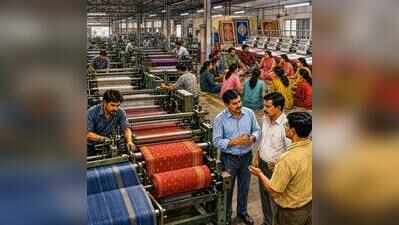
Surat: Weaving units across Surat continue to operate without disruption despite the ongoing protests by embroidery workers, which have led to three months of negotiations over wage restructuring.Industry stakeholders attribute the stability to production-linked wages, regular dialogue between workers and employers and weekly holidays.In the country’s largest man-made fabric manufacturing hub, which has a daily production capacity of six crore metres, weaving operations have remained unaffected despite alleged attempts by certain elements to disrupt work.The local textile sector employs around 15 lakh workers, with more than half engaged in weaving and the rest in embroidery, processing and other segments.Industry representatives said uninterrupted weaving operations stem from regular engagement between employers and workers, a wage structure linked to per-metre production and weekly leave. Workers in weaving units have not objected to 12-hour shifts as earnings are directly tied to output, with rates varying according to fabric type.Embroidery workers, meanwhile, are seeking an eight-hour shift while demanding wages equivalent to those paid for a 12-hour shift. Workers in embroidery units earn about Rs 30,000 on average. Stakeholders said earnings are broadly comparable with those in weaving when measured against production output. They also cited the absence of a weekly off in many embroidery units as a key difference.The Federation of Gujarat Weavers’ Welfare Association (FOGWWA) recently urged its members to avoid conflict with workers and resolve issues through discussion.“The workers are paid per metre of production and different fabrics have different wage rates. We have been giving a weekly day off when the shift changes,” said Vijay Mangukiya, a weaving unit owner in Amroli, where the embroidery protest turned violent in August.Stakeholders also pointed to differences in production cycles. Weaving units generally operate throughout the year, including periods of weak demand, while embroidery activity expands or contracts depending on orders received. Temporary stoppages in embroidery units can lead to layoffs, while periods of high demand often require overtime work.“In the Kadodara industrial area, due to power staggering, we give a day off every Thursday. We discuss with workers if they have any issues and, in most situations, we resolve things in a way that is acceptable to both parties,” said Umesh Vekariya, president of the Jolwa Industrial Association in Kadodara.


