


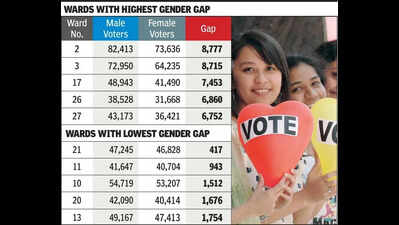
Surat: The latest ward-wise voter data of the Surat Municipal Corporation reveals a persistent gender gap across the city, with male voters outnumbering female voters in all 30 wards. Of the total electorate of 24.76 lakh, there are 13.02 lakh male voters, 11.73 lakh female voters and just 81 third-gender voters. The widest gender gaps are seen in wards dominated by migrants from Saurashtra. Experts have linked the imbalance to the historical prevalence of female feticide, noting that the situation has improved over the years. Ward 2, which includes Amroli, Mota Varachha and Kathore, has the highest number of electors at 1.56 lakh, comprising 82,413 males and 73,636 females. The ward also records one of the largest gender gaps, with 8,777 more male voters than female voters. Ward 3 — covering Varachha, Sarthana, Simada and Laskana — shows a similar imbalance, with a gap of 8,715, pointing to a continued skew in densely populated areas. In Ward 17, Puna (East), the difference stands at 7,453. Among southern and eastern wards, Ward 26 — Godadara and Dindoli (North) — has a gap of 6,860, while Ward 27 — Dindoli (South) — records 6,752 more male voters than female voters. “Single male migration is not common in those coming from Saurashtra to work here. They mainly migrate as a family. The gender gap can thus be directly linked to female feticide, which was rampant around two decades ago. In the younger population, the situation must have improved,” said Kiran Desai, a social science researcher. In contrast, Ward 10 — Adajan, Pal and Ichhapore — stands out for having the lowest gender difference among the more populous wards. It has 54,719 male voters and 53,207 female voters, a gap of just 1,512. Ward 21 — Soni Faliya, Nanpura, Athwa and Piplod — records one of the smallest gaps overall, with only 417 more male voters than female voters. It also has the highest number of third-gender voters at 15. However, smaller wards also show significant disparities. Ward 15 — Karanj and Magob — has 26,489 male voters and 21,922 female voters, a difference of 4,567 despite its lower population. The data indicates that while male voters outnumber females in every ward, the extent of the disparity varies widely. Urban density, migration patterns and socio-economic factors appear to be influencing the distribution. According to senior govt officials, many male workers migrate to Surat from states such as Odisha, Bihar and UP, but many are not registered as voters, which reduces the visible gender gap in areas with a high migrant worker presence.


