


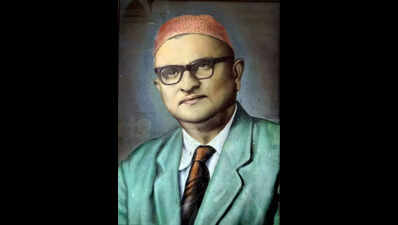
SLUG: International Mother Language DaySurat: When Gujarat was finding its administrative voice in the years after statehood, a quiet Parsi educator from Surat was busy shaping the way that voice would be written down. Long before computers and keyboards entered offices, Naushirwan Karanjia gave Gujarati a faster, functional script of its own — a shorthand system that helped the young state record its ideas, decisions and debates, one stroke at a time.Karanjia, a tutor by profession, invented Maher Laghulipi, the first structured Gujarati shorthand system, and went on to train the initial batch of govt officials after the formation of Gujarat in 1960. At a time when administrative efficiency depended entirely on handwritten records, his work played a vital role in strengthening institutional communication.Though his formal education ended after matriculation, Karanjia was widely respected as an accounting teacher who mentored several CAs in Surat. His intellectual journey, however, was shaped by his fascination with shorthand. Inspired by the prestige attached to English shorthand proficiency and the gold medals awarded to its toppers, he mastered the system and began teaching it. That pursuit eventually led him to recognise a crucial gap — Gujarati had no shorthand of its own.In the 1950s, when offices relied heavily on stenographers and note-takers, shorthand training was essential for staff assisting senior officials in both government and private organizations. “There were no computers or mobile phones then. Shorthand was the fastest and most reliable way to record information,” recalled his elder son, Yazdi Karanjia.Around 1954, Karanjia began working on Gujarati shorthand, despite not being formally trained in the language. “He realised that Gujarati needed its own system for official use,” said his younger son, Rohin Karanjia. Developing the script was a painstaking process that took nearly a decade, requiring repeated experimentation to ensure speed, clarity and consistency.After Gujarat was carved out as a separate state in May 1960, the need for documentation in Gujarati increased significantly. Then state minister Hitendra Desai approached Karanjia to explore the feasibility of using Gujarati shorthand in govt offices. Karanjia took on the responsibility of training govt staff and preparing a reference book on the system.In 1966, he trained the first batch of 18 govt officers drawn from Ahmedabad, Vadodara, Dahod, Godhra and other regions. The training coincided with the publication of the first part of his Gujarati shorthand book. Publishing the work itself posed challenges, as specialised printing blocks for shorthand symbols were unavailable at the time. With support from colleagues and well-wishers, the first part was finally released.Karanjia passed away suddenly in Aug 1966, just as the second part of the book was nearing publication. His death left the shorthand training programme incomplete. However, Rohin stepped in to carry forward his father’s work. Trained in Mumbai, he painted the basic designs of each shorthand symbol and continued training govt staff, many of whom achieved writing speeds of 60 to 80 words per minute.“My father had promised that he would not charge govt officials for training,” Rohin said. “We honoured that promise even after his death, though we were later asked to take fees.”


